Facing
Financial
Realities
In this new series “Facing Financial Realities”, we plan to offer an open and transparent look at the archdiocese’s finances. Through articles, infographics and videos, the series will detail our present financial situation, how the finances of our archdiocese and our parishes operate, and explore the work being done to address each challenge ahead.
It is said that one must first understand a problem before finding a proper solution. By transparently and effectively explaining the financial realities of our archdiocese and our parishes, we hope everyone will be better informed and better prepared as we work to make our archdiocese more financially sustainable and self-sufficient.
If you have any questions on any of the information presented here, please send your questions to comdirector.agm@outlook.com and we will look to answer them in upcoming articles.
A first look at the archdiocese’s growing financial challenges
Financially, the Archdiocese of Grouard-McLennan has never been a self-sustaining entity. In recent years, as costs in utilities, insurance and maintenance have increased, our hopes toward self-sustainability have only become harder to achieve.
In this first article, we want to present a comprehensive overview on the financial realities of the archdiocese. We will present how, in the last few years, it has become harder and harder to balance our books and manage an equitable budget. We will present an overview of the 2024 financial report and highlight some of the areas of concern and struggle we faced.
Let’s begin with a little financial history. Before becoming an archdiocese in 1967, we were the Vicariate of Grouard, a ‘Missionary Territory’. As a Vicariate, we were dependent on funding received from the Dicastery for the Evangelization of Peoples at the Vatican for our operations. These funds are generated by the annual special collection held in October, known as the ‘World Mission Sunday’ collection, where money collected around the world is provided to newly formed mission territories.
While becoming an archdiocese meant a greater degree of independence, the need for financial support did not go away. Between 1967 until the mid-90s, we continued to receive funding from Rome. However, a decision was made to cease these funds and a final subsidy was received in 2020. The other major source of revenue that sustained our needs was generated through the 10% cathedraticum fee (the money the archdiocese receives from parishes and missions through the Sunday collection). In 2011, this percent was raised to 13% on all income generated by the parishes. There were also donations received and in more recent years a couple thousand dollars annually from the Archbishop’s Dinner and other fundraisers. However, these have never been able to fully cover our expenses and needs.
Grants applied for through Catholic Missions in Canada (CMIC) have sustained us over the past decade and a half, but we cannot continue to count on them for financial aid going forward. With the end of funding from the Vatican, the CCCB established a partnership of the six northern dioceses affected by this loss of funds with the larger southern Canadian dioceses. The Archdiocese of Grouard-McLennan was partnered with the Archdiocese of Toronto. In this agreement with Toronto, we apply for funding from an account that has been set aside for us, for building renovations, construction or other special needs. This account is made up of one quarter of a special collection taken up in the Archdiocese of Toronto in the fall of each year. We will write more on the relationship we have with the Toronto partnership and the CMIC grants in the fourth article of this series.
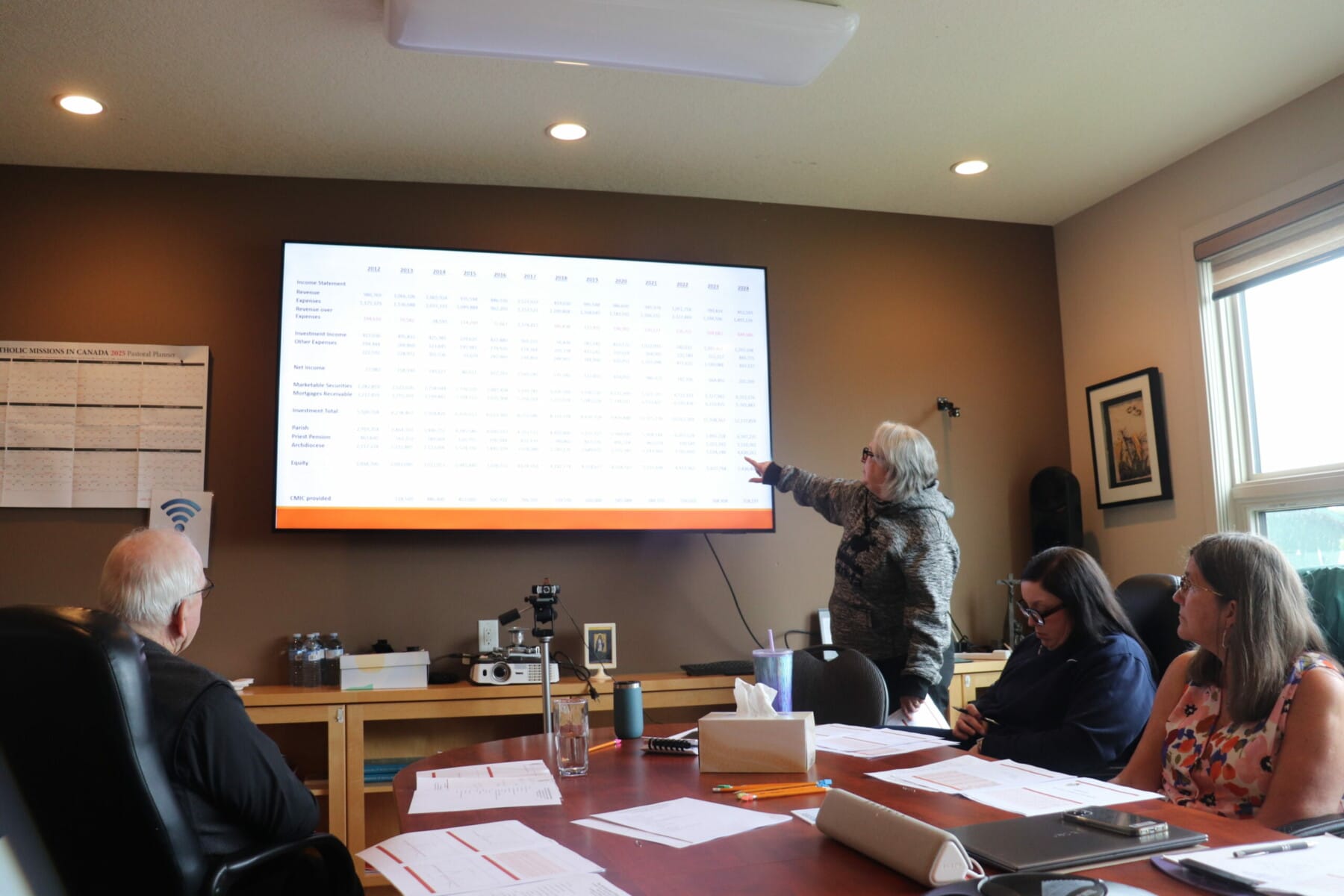
In the above paragraphs was an overview of our revenues (our investment portfolio will be detailed in article three). So what makes up the majority of our expenditures? The basic operations of the archdiocese today include: 1) providing a living allowance for our priests; 2) providing for the financial needs of the archbishop and his ministry; 3) costs of the chancery: salaries, utilities, equipment, supplies, etc. 4) expenses for archdiocesan events like the archbishop’s visitation and dinner, ordinations, special liturgies and celebrations, etc. 5) of our 62 churches, 30 are identified as ‘missionary communities’. Our missions depend on the chancery to pay expenses for utilities, supplies and other needs in these churches and rectories. Many of our facilities are also in need of repairs and renovations – some of them being major needs.
You can get a more detailed overview of these expenditures and the expenses in each ministry through our annual reports, which can be viewed at archgm.ca/annual-reports
Another major expense we have acquired in the 21st century is the cost of bringing Fidei donum clergy (priests from outside of Canada and the archdiocese) to serve this local church. First, we commit to paying the airfare and transportation costs, and provide an allowance to the priest as soon as he arrives. Secondly, we pay for a driving course and licensing fees so that they can drive a vehicle in Canada. These are just some of the basic expenses covered by the archdiocese.
In the last 25 years, the archdiocese has had highs and lows in its efforts to be more financially stable. There are years where we have received substantially large donations, and years where we have had to make large payouts through things like the priest’s pension plan, the Indigenous Reconciliation Fund or lawyer fees.
As we take a look at the archdiocese’s revenue and expenses since 2012, we see that the archdiocese usually finds itself with a significant deficit at the end of each year. (Please note: the deficits listed here do not include the income the archdiocese receives from its investments each year, which will be detailed in Article 3).
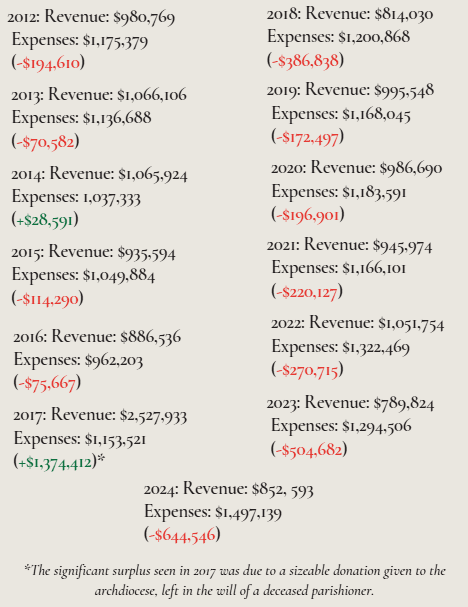
As shown, our annual deficits seem to be climbing with each passing year. What are some of the causes? We can attribute it to a number of factors, from a decrease in revenues to growing inflated expenses. In many places, church attendance has not recovered since the COVID-19 pandemic. The post-pandemic world has also been one of intense inflationary increases in the cost of living, and the archdiocese, like many charitable and not-for-profit organizations, have been hit hard by these rising costs. Added to all this has been the reassessment of all our churches, rectories and other properties due to changing market factors and insurance policies. This has caused an increase in insurance costs.
An example of how drastic the costs of property insurance have risen can be easily seen at the parish level. Roger Loberg, Chair of the Archdiocesan Finance Council and a parishioner at St. Mary’s Church in Beaverlodge, notes that the insurance costs of our churches have more than doubled in the past five years.
“The example I would use is that in 2020, in my home parish in Beaverlodge, we were paying around $600 a month for insurance. In 2025, it’s more than $1,300 a month that we are paying,” said Loberg. “So insurance is by far the biggest increase in cost. Utilities have gone up also, around 30% in the past five years. Most other costs for our parishes have increased more moderately.”
While there are general increases in expenses happening because of these rising costs, each year there are also unique circumstances that contribute to rising expenses. For example, in 2023 there was $156,418 spent in the area of building and maintenance in order to do a major repair on the former chancery building in McLennan. In 2024, only $22,103 was spent in this area. As well, in 2024 there was a significant increase in expenses from the Office of the Vicar General ($147,365 was spent in 2024, whereas only $84,420 was spent the previous year). This was due in part to the departure of five Fidei donum priests and the need to recruit five priests to replace them.
In hope of being more financially transparent, the archdiocese has held an annual finance meeting every spring since 2009. At these meetings, the archbishop, finance administrator, chancery staff, pastors and members of every parish finance council and pastoral council come together to get a concrete picture of how the archdiocese is faring financially. It also provides an open forum for discussions and to tackle any questions or concerns people may have.
“The archdiocese sought to be more transparent with all of our parishes by having these annual meetings, and we encourage those attending to report the information back to their parishes,” Finance Administrator Paulette Carrier explained.
The archdiocese is projecting one of its largest deficits at the end of the fiscal year 2025. This stark projection was presented at this year’s annual meeting held on April 26th in Peace River, where the financial report for the calendar year of 2024 was reviewed, as well as a projected budget for 2025.
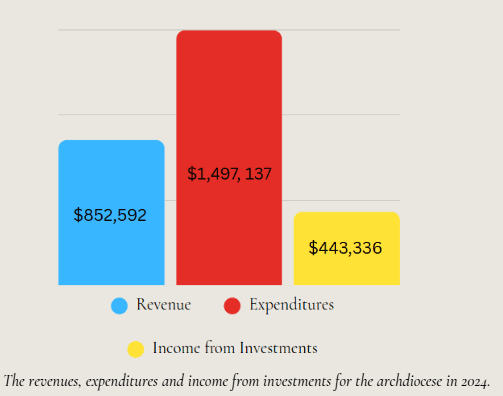
Looking at the 2024 year end report, there was a total revenue of $852,592 recorded and an expenditure of $1,497,137, making a deficit of $644,545. In 2024, the investment portfolio had a return on its investments of $443,335, cutting the 2024 deficit to a total of $201,209 of debt. In a positive note: $325,898 in interest was paid out to parishes and groups who have invested in the portfolio. The total interest gained from the investment in 2024 was $769,235. This affirms the importance of parishes investing surplus money through the archdiocese.
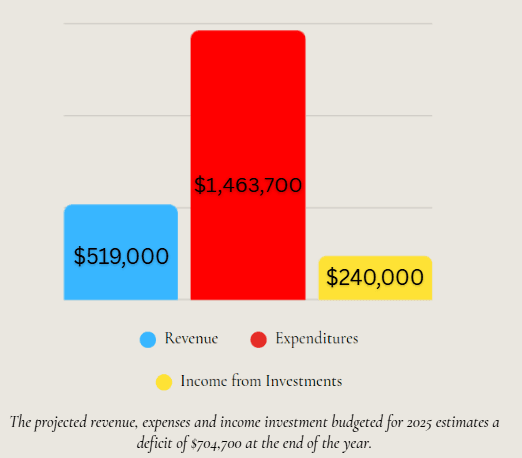
In preparing a 2025 budget, the Finance Council based its projection on the 2024 revenue/expense information. In using these numbers, we will face a substantial deficit until we know what the financial markets do and the hopes of a substantial interest on investments. There is some skepticism as to a good investment outcome for 2025, as we see markets dropped at the beginning of this year and there is uncertainty of what will be faced with the United States tariffs and the stock market.
It is also important to note that we will not receive any funding from CMIC for the year 2025. CMIC has, in the past, provided funds to cover the costs of operation for many of our missions. It also supported our seminarians and the Office of Evangelization and Catechesis to around $300,000 annually.
While this article paints a particularly stark picture for the financial wellness and security of the archdiocese, we can each do our part, first, through faith and prayer, and secondly, to contribute generously with our time, talent and treasure to the stability and resilience of our parishes and archdiocese. If you have any questions concerning this article, please contact the Communications Officer at comdirector.agm@outlook.com
Article prepared by Monsignor Charles Lavoie PH, Vicar General and Chancellor, and Kyle Greenham, Communications Officer
August 05, 2025