Article 4: Catholic Missions in Canada & the future of the Archdiocese of Grouard-McLennan
Catholic Missions in Canada (CMIC) provides funding to dioceses across Canada, focusing on missionary regions in some of the most rural, isolated and remote communities of the country. CMIC has been fulfilling this mission for more than a century.
The organization was founded on September 23rd, 1908, under the designation of the Catholic Church Extension Society of Canada. In 1910, Pope Pius X formerly constituted the Society, recognizing it as a Pontifical Society of the Church. It was in 1999 that the Society changed its name to Catholic Missions in Canada, to better reflect the nature of its aims and operations.
CMIC relies on donors from across Canada, as well as from fundraising events, as its funding resource. In recent years, a annual collection is held for CMIC, where they raise funds from the collection that used to go to the Scarboro Missions society. Grants are distributed to missions in the dioceses that apply for funding, and through interest received from CMIC investments.
The funds requested from dioceses have to be for a mission church/parish, and can include, firstly, sustenance, travel, utilities, insurance, administration and facility and property maintenance; secondly, formation for lay and religious (adult and youth) and finally it covers a partial cost of seminarian formation. Each application needs to be presented for each individual need of the missions or programs.
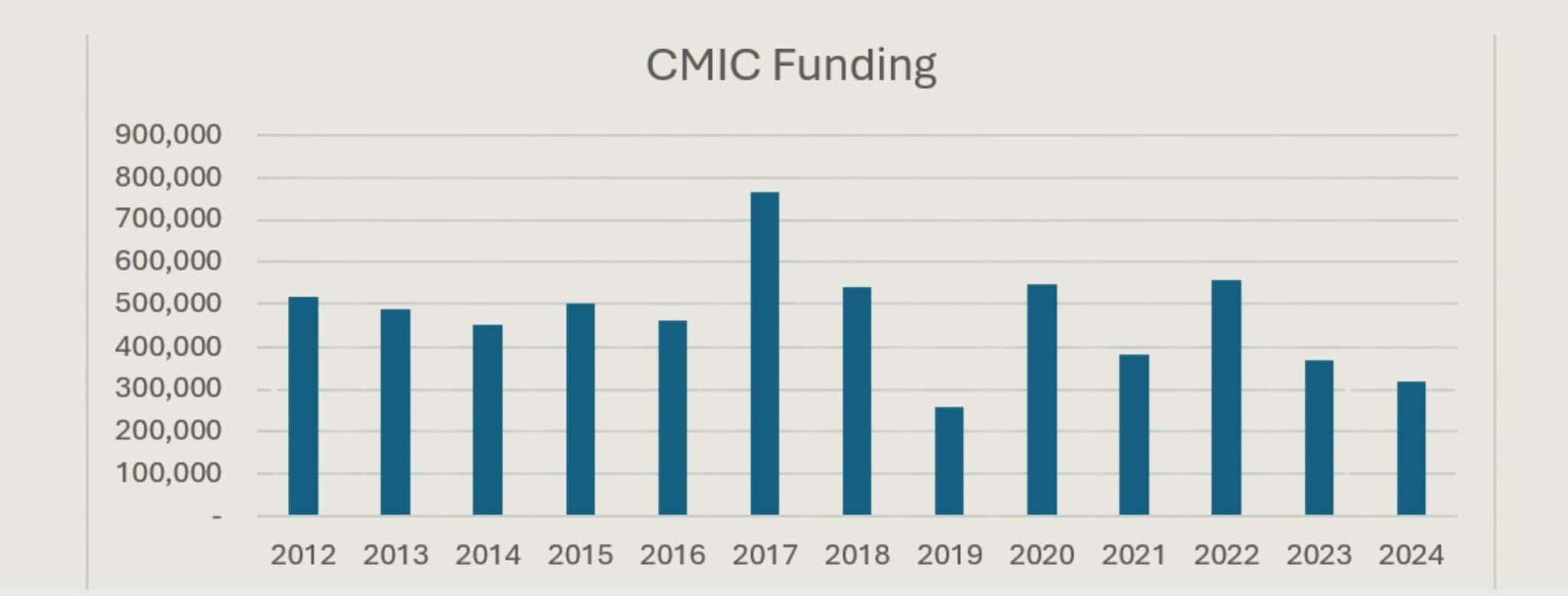
In the past fifteen years the Archdiocese of Grouard-McLennan received from CMIC the amount to cover a maximum of 75% of its cost for missions and other programs. This chart details this funding from 2012-2024:
With CMIC funding for special projects, we were able to do repairs or improvements to our buildings, like the church in Trout Lake in 2009, the rectory in Fox Lake in 2010, the church in Fox Lake in 2012, the church and rectory in Assumption in 2016, the house in John D’Or Prairie, the church and rectory in Joussard, and the church in Meander River in 2017.
For some time, our northern missions (of which there are ten), were served by two priests stationed in and serving from the parish of High Level. The north was served by those priests, two nuns from the Sisters of Ste. Chretienne and one lay person. With the departure of the two sisters from the Little Red River Cree Nation area, Archbishop emeritus Pettipas wanted to have a priest stationed to serve in Chateh, High Level, Fort Vermillion, and in the Little Red River Cree Nation. Each priest was assigned a maximum of three or more church communities. In this northern area of the archdiocese alone, we are now served by four priests celebrating Mass every weekend. In the rest of the Archdiocese, we are also serving 19 other Indigenous missions.
In 2019, CMIC refused all funding to the Archdiocese of Grouard-McLennan. After multiple meetings with the CMIC allocation committee, we were able to prove our need and the board consented to give us an amount of $250,000, which would cover only 50% of our expenses for our missions and formation groups.
The application made for 2025 and for 2026 were refused by the CMIC allocation committee. CMIC wants the Archdiocese to use the principle of its investments before it receives funding. Keep in mind, the Archdiocese is presently using the interest made on this principle to cover some of its operating costs.
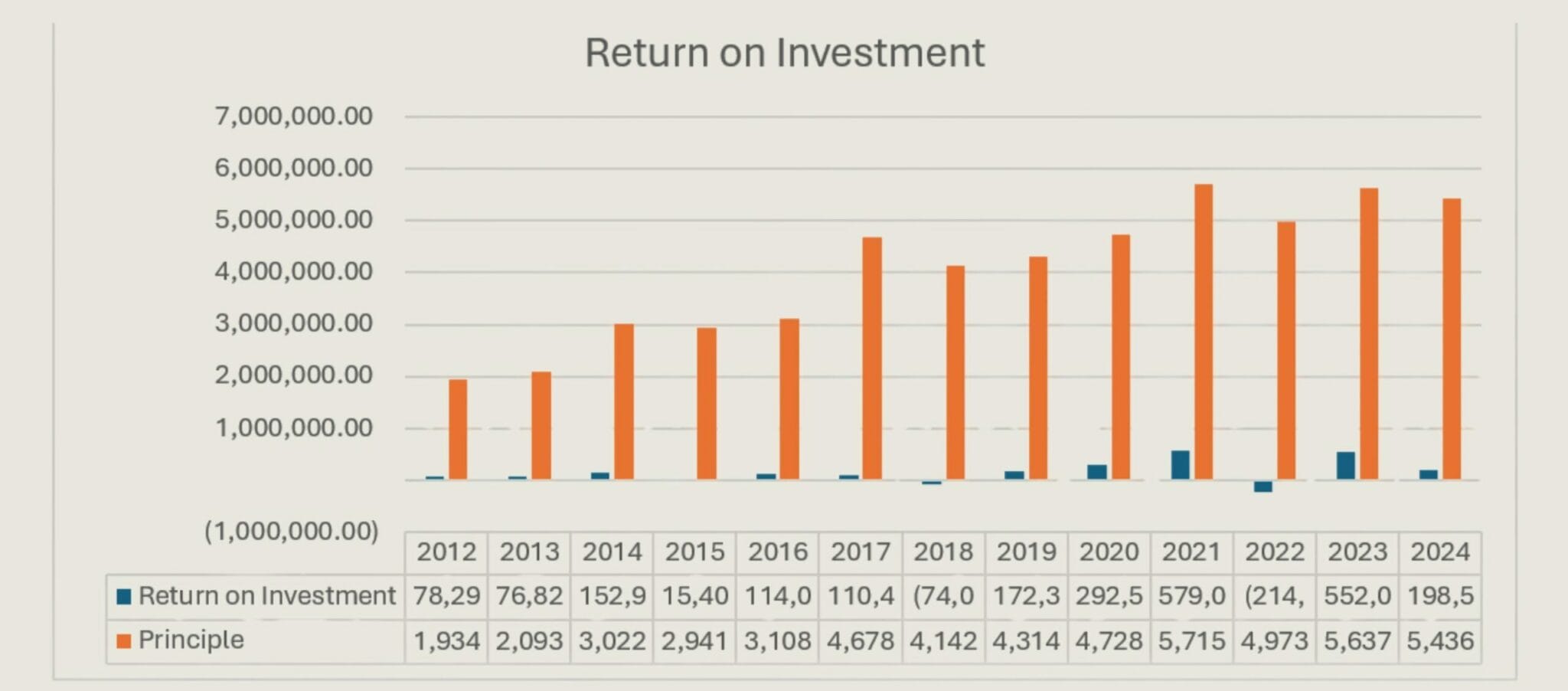
If we follow the direction of the CMIC allocation committee, the $4,000,000 principle amount we have invested at this moment, $3,000,000 of it belonging to parishes, would only sustain us for the next four years. Our return on investment since 2024 is shared below:
For this reason, the archdiocese is looking to become financially self-sufficient. In order to achieve this goal, we need to cut costs and increase revenue. In the near future Archbishop Duval is looking to select an Ad Hoc Committee to advise him on the situation facing our churches. This Ad Hoc Committee will be led by our Finance Administrator and will consist of lay members from each deanery, with knowledge of the entire Archdiocese and its demography, locations, finances and pastoral needs.